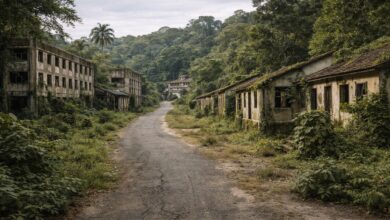
On the western plains of Azerbaijan, the city of Aghdam spreads outward in straight lines that no longer lead anywhere. Apartment blocks, schools, factories, and civic buildings remain standing, but without glass, doors, or movement. Streets still follow an urban plan, yet nothing circulates within them. Aghdam was not abandoned gradually through economic decline or environmental pressure. It was emptied during armed conflict, leaving behind an intact city stripped of life.
What defines Aghdam is scale. This is not a village or an industrial site. It is a full city, preserved not by care but by cessation. Concrete shells stretch across an uninhabited grid, turning urban order into evidence of interruption.
A planned city before rupture
Before its destruction, Aghdam functioned as a regional center with housing, industry, education, and culture. Its layout reflected twentieth century urban planning. Residential districts radiated from civic cores. Infrastructure was built to support growth and permanence.
Life in Aghdam was dense and ordinary. Markets operated. Schools opened daily. Streets carried routine movement rather than ceremony. Similar human responses to silence and environment appear in ruins of Belchite.
The city existed for continuity.
Conflict and forced emptiness
During regional conflict in the early 1990s, Aghdam became uninhabitable. Residents fled under pressure, leaving behind homes and institutions. The departure was not symbolic. It was physical and immediate.
Buildings were damaged or repurposed, but many remained structurally upright. What vanished was population.
The city transitioned from inhabited to empty without intermediate adaptation.
Why structures remain standing
Aghdam’s buildings were largely constructed from reinforced concrete. These materials resist collapse even when stripped of interiors and maintenance.
As a result, the city did not crumble quickly. Walls stayed upright. Blocks retained their mass.
What remains is volume without function.
The grid as a frozen system
Urban grids are designed to distribute life efficiently. Roads connect services. Housing aligns with access. When emptied, the same grid emphasizes absence.
In Aghdam, streets stretch forward with no destination. Intersections remain legible but unused.
The system persists without purpose.
Concrete shells and exposed interiors
Many buildings stand hollow. Windows are open to air. Floors are bare. Stairwells lead upward without end.
These shells reveal how cities are layered. Private spaces sit within public frameworks. When interiors disappear, structure becomes skeletal.
Exposure changes scale perception. Buildings feel larger without use.
Silence shaped by magnitude
Silence in Aghdam is expansive. Unlike small abandoned sites, sound has space to travel and dissipate.
Wind moves through corridors. Footsteps echo briefly, then vanish.
The city absorbs sound rather than reflecting it.
Why unease is often reported
Visitors frequently describe unease in Aghdam. This reaction is not rooted in uncertainty. The cause of abandonment is known.
Unease arises from confrontation with scale. A full city was built to hold tens of thousands of lives. Its emptiness is absolute.
Magnitude amplifies loss.
Absence without substitution
Many abandoned cities are repurposed or reoccupied. Aghdam remained unused for decades.
No informal settlement replaced the original one. No new function emerged.
The city exists in a state of suspension.
Public buildings without public
Cultural centers, schools, and administrative buildings remain identifiable. Their forms still suggest gathering.
Without people, these spaces feel disproportionate. Rooms designed for crowds hold only air.
Public absence feels heavier than private absence.
The mosque as vertical marker
Among the ruins, a mosque rises above surrounding structures. Its form remained visible long after surrounding neighborhoods emptied.
Religious architecture often becomes a landmark in abandoned cities because it was built to endure.
In Aghdam, it functions as orientation point rather than center of activity.
The difference between ruin and erasure
Aghdam was not erased from the landscape. It was erased from use.
This distinction matters. Erasure removes memory through absence. Aghdam preserves memory through exposure.
The city remains present enough to resist forgetting.
Urban memory without residents
Cities carry memory through repetition. When repetition ends, memory becomes static.
In Aghdam, memory is locked into architecture rather than routine.
Streets remember where people walked. Buildings remember how they were used.
Comparison with other abandoned cities
Many abandoned cities result from economic collapse or environmental disaster. Aghdam differs because it was depopulated through conflict while remaining largely intact.
Its condition reflects interruption rather than failure.
Interruption leaves sharper outlines.
Ethical distance and documentation
Engaging with Aghdam requires restraint. It represents displacement and unresolved political reality.
Curiosity risks aestheticizing loss. Documentation must remain factual and measured.
The city is not a spectacle. It is consequence.
Time without decay narrative
Time in Aghdam does not read as gradual decay. Years passed without transformation because use did not resume.
Weather altered surfaces, but not function. Function had already ended.
Time accumulates without story.
Presence without legend
Unlike many abandoned places, Aghdam has not generated folklore of unexplained presence. Its gravity does not need narrative.
The facts are sufficient.
Silence speaks clearly.
Why the city still matters
Aghdam matters because it demonstrates how conflict can empty urban space without removing its form. It shows how cities can be stopped rather than destroyed.
This condition is rare and instructive.
It forces recognition rather than imagination.
A city defined by interruption
Aghdam is defined not by what happened within its streets, but by what ceased happening.
Movement ended. Use ended. Continuity ended.
The city remains as a record of that ending.
Enduring Perspective
Aghdam endures as a former city emptied during conflict, where concrete shells stretch across an uninhabited grid. Its power lies in scale and clarity rather than mystery. Nothing here is hidden. The absence is complete and visible.
The city does not ask to be reinterpreted. It stands as evidence of interruption on an urban level, where planning, infrastructure, and architecture outlived the life they were meant to support.
In the open plains of Azerbaijan, Aghdam remains a reminder that cities are not only built by people. They are also undone when people are forced to leave, leaving behind structures that continue to occupy space long after life has been removed. Related reflections on memory and perception can also be found in mining settlement of Garnet.
Horizon Report documents places shaped by memory, infrastructure, and human decisions. Our editorial approach focuses on what remains physically visible, how abandonment unfolds over time, and how interpretation is clearly separated from observable evidence.
For readers seeking deeper context, the following background articles explore how ghost towns emerge, why communities are left behind, and why preservation matters in understanding collective history.
- Abandonment And Ghost Towns
- What Is A Ghost Town
- Why Towns Are Abandoned
- Preserving Abandoned Places
Editorial transparency matters. Observations are grounded in site layout, materials, remaining structures, and documented timelines where available. Interpretive layers are presented as interpretation, not assertion.
Careful readers often notice details worth refining. Thoughtful feedback helps ensure accuracy, clarity, and long term editorial integrity.